







Stablecoin Transaction Fees: What You Really Pay
Network fees on stablecoin transfers can be fractions of a cent, but on/off-ramp and FX costs set the real price. See what each layer costs and how to choose.

The network fee on a stablecoin transfer is often a fraction of a cent, but it is rarely the biggest cost. Converting money into a stablecoin and back out again, plus any currency exchange, usually decides what a payment costs. Below, we break the total into its layers, show how much the same USDT transfer can differ by blockchain, and explain how to pick a stablecoin for payments. This is educational information, not financial advice.
Cryptela
Compare Stablecoin Markets With More Context
Explore cryptocurrency prices, trading volumes, and market data to put stablecoin transaction costs in a broader market context.
Explore Crypto MarketsKey Takeaways
- A stablecoin payment has four cost layers: on-ramp (buying the stablecoin), network fee, FX spread, and off-ramp (cashing out). One industry guide puts the all-in cost at 0.5% to 2.5%, against 3% to 7% for SWIFT.
- The same USDT transfer can cost under a tenth of a cent on one chain and about $2 on another, according to a November 24, 2026 sample.
- Conversion into and out of fiat, not gas, usually sets the price of a payment.
- Reserve disclosures, redemption terms and network support matter as much as the fee when you choose a stablecoin.
- Stablecoins carry risks of their own, including reserve quality, depegging and regulatory change.
Table of Contents
- The Four Layers of a Stablecoin Payment Cost
- How Network Fees Differ by Blockchain
- Choosing a Stablecoin for Payments
- Reading Reserve Transparency
- Market Cap Rankings: What They Tell You
- How Widely Are Stablecoins Used for Payments?
- Risks to Understand Before You Use Stablecoins
- Reaching Stablecoin Readers
- FAQ
- Sources
The Four Layers of a Stablecoin Payment Cost
A stablecoin is a cryptocurrency designed to hold a steady value, usually one US dollar. Sending one looks simple, but money normally enters and leaves the system through traditional banking, and each step has a price. Industry practitioners call this the “stablecoin sandwich”: fiat in, stablecoin across, fiat out.
The Tazapay guide, published in April 2026, gives these typical ranges:
| Layer | What it is | Typical cost |
|---|---|---|
| On-ramp | Converting fiat into the stablecoin | 0.1% to 0.5% |
| Network fee (gas) | Paid to the blockchain that processes the transfer | Under $0.01 on most networks; $0.20 to $2.00 on Ethereum mainnet |
| FX spread | The gap between market and quoted exchange rates | 0.1% to 2.0% |
| Off-ramp | Converting the stablecoin back to local currency | 0.1% to 1.5% |
The off-ramp is typically the largest single component. The Paypers Global Stablecoins Report 2026, produced with Worldline, puts conversion fees at 0.5% to over 2% per leg, so a round trip can reach 1% to 4% before anything else. Its conclusion is that an honest cost comparison has to include the full on-ramp and off-ramp, not only the blockchain fee.
The IMF’s December 2025 paper makes the same point: blockchains cut reconciliation costs through a shared ledger, but stablecoins still need wallet providers, exchanges, validators and FX settlement, so end-to-end costs include the whole stack.
A worked example
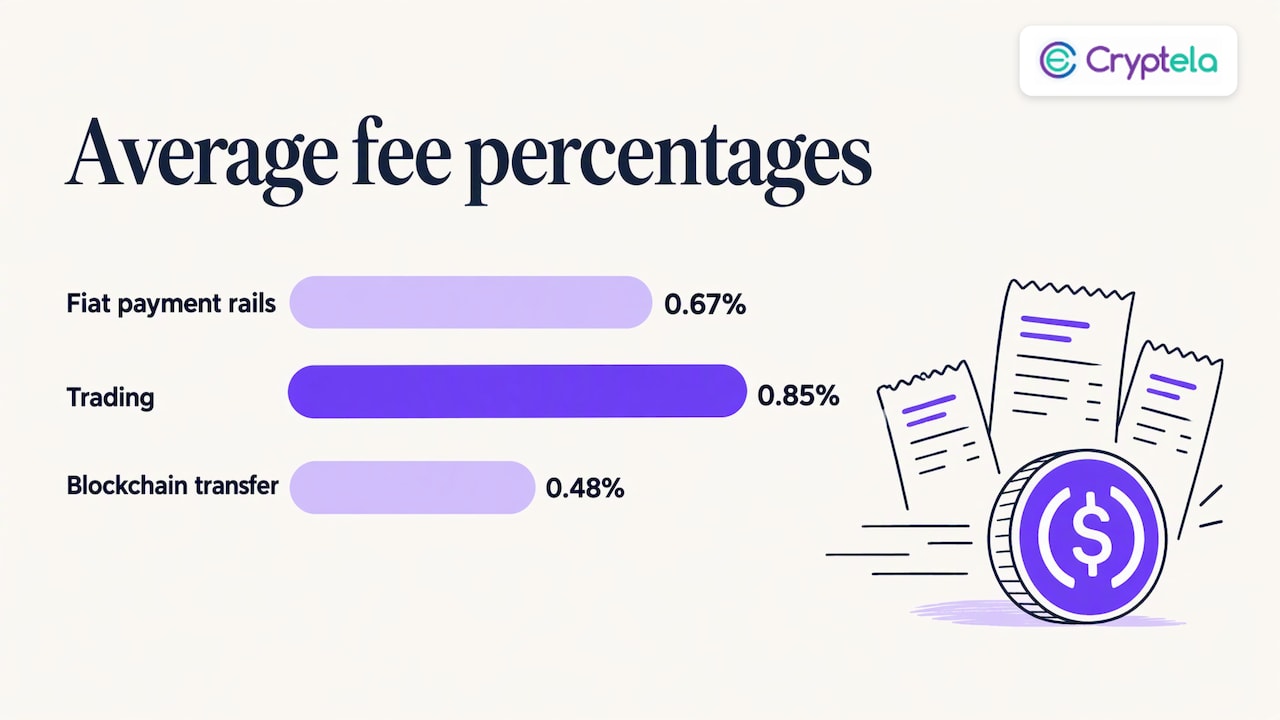
Say you send the equivalent of $200 across a border. A study cited by BIS and IMF work, as summarized by Reap Technologies, found fiat payment rails averaged 0.67% and trading fees 0.85%, while the blockchain transfer itself averaged 0.48%. In dollars, the on-chain part is under $1, and the ramps account for most of the rest. Your own total depends on your provider, corridor and amount, so read the quoted rate and fees before confirming.
For comparison, the IMF paper cites research suggesting a $500 transfer through stablecoins could cost $5 to $10 versus $20 to $30 through traditional rails. Competition among on/off-ramps in some corridors has pushed stablecoin transfers to parity with established providers or below.
How Network Fees Differ by Blockchain
The network fee is the payment to validators for processing your transfer. It depends on which blockchain carries the token, and the same USDT can exist on many.
A sample taken on November 24, 2026 found these median USDT network fees:
| Network | Median USDT fee |
|---|---|
| Solana | $0.00047 |
| TON | $0.0013 |
| Polygon | $0.0016 |
| BNB Chain | $0.0018 |
| Arbitrum | $0.0022 |
| Avalanche | $0.0032 |
| Ethereum | $0.293 |
| Tron | $2.00 |
That is a 4,263x gap between cheapest and most expensive for the same token. A separate live tracker updated on November 25, 2026 showed under $0.0001 on Aptos and Optimism and $0.0041 on Ethereum, so the numbers move through the day. Treat any single reading as a snapshot: fees shift with network congestion and are refreshed continuously.
Why Tron costs more for USDT
Tron charges smart-contract calls in a resource called energy. Wallets without staked or rented energy burn the network token to cover it, and USDT pays a surcharge under Tron’s dynamic energy model, per the Align tracker. A first transfer to an address that has never held USDT costs more: about $4.05 on Tron and $0.108 on Solana in the November 24 sample.
Why Ethereum fees swing
Ethereum gas has two parts: a base fee set by the network and a priority fee, or tip, that moves your transaction up the queue. FXC Intelligence notes the base fee is burned, validators earn the tip, and fees are paid in ETH, not in the stablecoin you send. That means you need a small ETH balance even when moving only USDC.
Some wallets are removing that friction. OKX Wallet, for example, added a smart account feature that lets users pay gas in USDT or USDC on multiple chains.
Choosing a Stablecoin for Payments
Cheap is not the only criterion. FXC Intelligence points out that Ethereum is popular for stablecoins not because it is inexpensive but because wide usage gives major stablecoins deep liquidity. Use this checklist:
- Network support. Confirm the recipient’s wallet or exchange accepts the token on the same chain you send on. A transfer on the wrong network can be lost.
- Total cost. Add on-ramp, network, FX and off-ramp fees for your specific corridor.
- Liquidity. Larger tokens are easier to convert in volume with tighter spreads.
- Redemption. Know who owes you the dollar, what backs it, and how long redemption takes.
- Reserve disclosure. See the next section.
Regional on-ramps are widening the options. Banxa’s integration with Sui, for instance, brought low-cost fiat on-ramps, and Ramp Network enabled fiat-to-crypto purchases on Polkadot. Local-currency tokens exist too, such as XSGD, a Singapore dollar stablecoin built for cross-border payments, which can reduce FX steps when you transact in that currency.
Reading Reserve Transparency
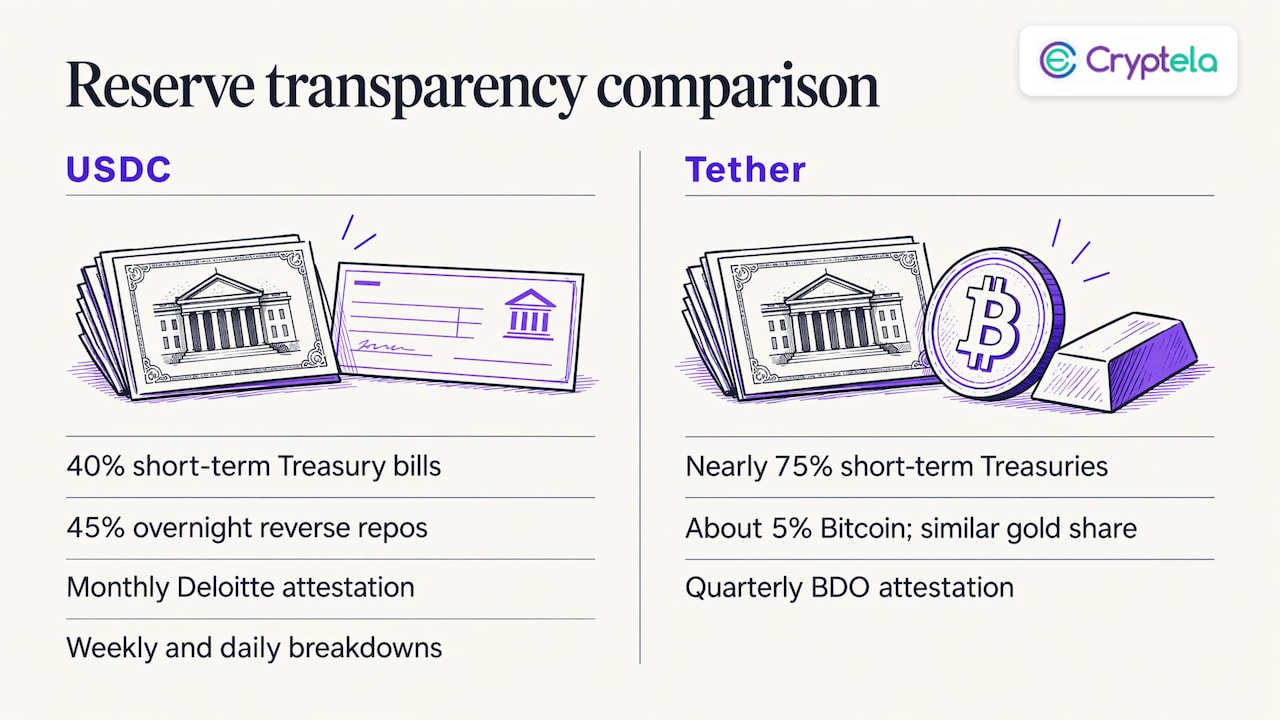
A stablecoin is only as good as the assets behind it. The IMF’s December 2025 paper reports that USDC reserves were about 40% short-term US Treasury bills and 45% overnight reverse repos backed by Treasuries, plus bank deposits, while Tether held nearly 75% in short-term Treasuries, with about 5% in Bitcoin and a similar share in gold.
Disclosure practices differ. According to Paypedia’s 2026 reference, Circle publishes a monthly attestation signed by Deloitte & Touche plus weekly and daily reserve breakdowns, while Tether publishes a quarterly attestation signed by BDO. An attestation confirms reserves at a point in time; a full audit is broader. The Motley Fool notes Tether has not yet had a full audit by an accounting firm.
Paypedia’s due-diligence frame is simple: who is the debtor, what backs the claim, and how long does redemption take. Read the issuer’s latest attestation before holding a balance you cannot afford to have stuck.
Market Cap Rankings: What They Tell You
Market capitalization for a stablecoin is the amount outstanding, not how much it is used for payments. Citing CoinMarketCap data as of November 2, 2026, The Motley Fool ranked the top ten:
| Rank | Stablecoin | Market cap |
|---|---|---|
| 1 | USDT | $179.88B |
| 2 | USDC | $71.24B |
| 3 | USDe | $4.57B |
| 4 | DAI | $4.53B |
| 5 | USD1 | $3.84B |
| 6 | USDG | $2.92B |
| 7 | PYUSD | $2.71B |
| 8 | RLUSD | $2.42B |
| 9 | USDY | $2.4B |
| 10 | USDf | $1.66B |
Tether and USDC together make up 82% of the roughly $308B market. These figures change daily, so check the Cryptela market cap page for live values before you decide.
How Widely Are Stablecoins Used for Payments?
Adoption is real but smaller than headline volumes suggest. The Paypers 2026 report, citing a Fireblocks survey of 295 financial institutions, found 50% to 71% using or planning stablecoin payments, with 71% in Latin America and 50% in North America. It also reports B2B payments at $36B annualized, yet stablecoins remain under 0.2% of the roughly $23.5T annual cross-border flow.
Visa has reported a $7B annualized stablecoin settlement run rate across nine blockchains, and Bitso processed $6.5B in US to Mexico remittances in 2024, about 10% of that corridor. A May 2026 BIS paper adds perspective: adjusted transaction volumes are about 1% of unadjusted values, which is why raw on-chain totals overstate payment use.
Risks to Understand Before You Use Stablecoins
Stablecoins are not risk-free. Plan for these:
- Reserve and issuer risk. Value depends on the quality and accessibility of backing assets and on the issuer’s ability to redeem.
- Depegging. Market price can drift from $1 during stress, especially for tokens with less liquidity.
- Concentration. About 98% of stablecoin value is dollar-denominated and two issuers dominate, per the BIS paper.
- Operational errors. Wrong-network sends and unfamiliar addresses can mean permanent loss.
- Regulatory change. Rules on issuers and on/off-ramps differ by country and are evolving.
- Ramp cost surprises. Spreads and fees can exceed the network fee many times over.
For tax, legal or compliance questions about a specific payment, consult a qualified professional in your jurisdiction.
Reaching Stablecoin Readers
If you run a payments project, exchange or on-ramp and want to explain your fees and reserves to this audience, Cryptela offers sponsored articles, press releases and other advertising formats, and you can submit an article for $99 as a one-off. Sponsored content is labeled as such and kept separate from our independent editorial coverage.
FAQ
How much is the USDT transfer fee?
It depends on the network. In a November 24, 2026 sample, the median ranged from $0.00047 on Solana to $2.00 on Tron, with Ethereum at $0.293. Fees change with congestion, so check a live tracker before sending.
Are stablecoin fees lower than bank transfer fees?
Often, but not always. The IMF paper cites research putting a $500 stablecoin transfer at $5 to $10 versus $20 to $30 on traditional rails. Ramp and FX costs vary by corridor, so compare the all-in quote.
Why do I need ETH to send USDC on Ethereum?
Ethereum gas is paid in ETH, not in the stablecoin being sent. Some smart-account wallets now let you pay gas in USDT or USDC instead.
What is the biggest cost in a stablecoin payment?
Usually the off-ramp, meaning conversion from stablecoin to local currency, which one guide places at 0.1% to 1.5%. Network gas is typically a small share.
How do I check that a stablecoin is backed?
Read the issuer’s latest attestation, note what assets back the token, and confirm how redemption works and how long it takes.
Sources
- The Stablecoin Sandwich Explained (Tazapay)
- The Paypers Global Stablecoins Report 2026 (Worldline)
- Understanding Stablecoins, IMF Departmental Paper (2025)
- How Stablecoin Payment Infrastructure Works (Reap)
- What it costs to send USDT on each network
- USDT and USDC Network Fees, Live (Align)
- Stablecoin fees: Understanding on-chain transaction costs (FXC Intelligence)
- Payment stablecoins (Paypedia)
- The Largest Stablecoins in 2026, Ranked by Market Cap (The Motley Fool)
- The Paypers Global Stablecoins Report 2026
- BIS: The impact of stablecoins on the international monetary and financial system
Recommended
What do you think about this article?
Share your reaction with the Cryptela community.
Get more Cryptela on Google
Add Cryptela as a preferred source for cryptocurrency news and analysis in eligible Google Search experiences.
CRYPTELA NEWSROOM
Share Your Crypto News With the World
Announce your blockchain project, product launch, partnership, or company milestone through Cryptela.
Submit a Press Release
No recent news available.